Past customers already know what it is like to work with you. A useful email can help them remember you when they need the service again, tell them about something genuinely relevant, or make their last purchase more valuable. It does not need to sound like a constant sales pitch. For many small businesses, one thoughtful message a month is a better starting point than an ambitious weekly newsletter that disappears after three issues.
This guide walks through building a small email program for a Roanoke Valley business: who to email, what to say, how to make the message easy to act on, and what to learn from the results. The examples are hypothetical. Use your own customer relationships and the rules that apply to your business and email service.
Begin with a reason people would welcome the message
Before collecting addresses, decide what a subscriber will receive. “Updates” is vague. “One monthly note with seasonal care tips and upcoming appointment openings” is clearer. A bakery might offer ordering reminders before major holidays and one practical serving tip. A bike shop might share maintenance reminders at the start of each riding season.
Write the promise in one sentence and use it where people join. If the actual messages become daily discounts after you promised occasional tips, subscribers will feel that the deal changed. A clear promise also makes writing easier: every proposed email either fits the purpose or does not.
Ask whether each message helps the reader do something. It might help them plan, avoid a mistake, learn a useful detail, or notice an opportunity that matters to them. If the only benefit is that the business wants more sales, add something useful before sending.
Tip: Start with the questions customers ask after they buy. Follow-up advice often makes the best first email because it demonstrates care, not just promotion.
Build a list people chose to join
An email address collected for a receipt or quote is not automatically an invitation to send every promotion. Be clear when someone is joining a marketing list. Explain the kind of messages and how often they will arrive. Keep a record of the sign-up source and make it easy for a person to leave the list.
Do not buy a list of local addresses or upload a pile of old contacts simply because you have them. A small list of people who want your messages is more useful than a large list of strangers who ignore them. Use an email service that handles delivery and unsubscribes instead of sending a large campaign from a personal mailbox.
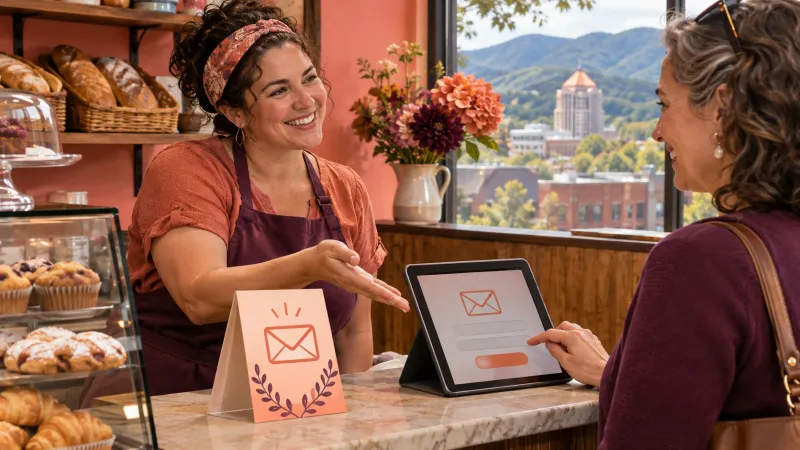
At a Roanoke shop counter, an employee could ask, “Would you like one email a month with new arrivals and practical gift ideas?” The customer can say yes or no without pressure. On a website, put the same promise beside the sign-up form. The words should match what you actually plan to send.
Tip: Review your sign-up form on a phone. If the purpose is hidden in tiny text or the form asks for unnecessary details, simplify it.
Keep the first version small
You do not need a complex series of automated messages to begin. Choose a monthly sending day, one person who owns the draft, and one person who checks it before it goes out. Put a few topics on the calendar so the next email is not invented at the last minute.
A simple calendar could include a seasonal question, a behind-the-scenes explanation, a useful checklist, a customer story shared with permission, or a timely availability update. You can mix these over several months. You do not have to promote a discount every time.
If your business has a busy season, prepare the next message early. If you miss a month, resume with something useful rather than apologizing at length. A consistent, realistic rhythm is easier for customers to recognize and for your team to maintain.
Tip: Draft three subject lines when you write the email. Choose the clearest one, not the cleverest. It should tell the reader what they will get.
Choose one job for each email
One email should have one primary purpose. It might remind customers to schedule a seasonal service, teach them how to care for a product, or announce a real change in hours. If you combine a new product, a staff profile, three promotions, and a long event recap, the reader may not know what matters.
Imagine a hypothetical Salem garden center in early spring. An email about “three things to check before planting” can give practical guidance, then mention that staff can help choose plants suited to a particular space. The advice and next step belong together. An unrelated sale on patio furniture would distract from the main point.
Write the action you want at the top of your draft: “Book a spring visit,” “Reply with a question,” or “Read the care guide.” Then make sure the body earns that action. If the message is purely educational, the next step may simply be to save the checklist.
Tip: Delete any paragraph that asks the reader to take a different action unless it is essential to understanding the main one.
Use a structure that works on a phone
A good small business email can be short. Open with a sentence that explains why you are writing now. Give the useful information in two or three short paragraphs or a compact list. End with one clear action and a human sign-off. Use descriptive link text rather than a long raw address.
For example: “Before the next cold spell, check the seal around an exterior door. If you can see light or feel a draft, take a photo of the gap and note which side of the door it is on. That information helps us recommend the next step.” A local home service company could then offer a link to request an assessment. The email teaches something even if the reader does not click.
Keep important words as text, not only in an image. Some people do not load images, and small text baked into a graphic is hard to read. Add descriptions to meaningful images. Test the email on a phone and on a desktop screen before sending.
Tip: If your email takes more than a minute to understand, move the extra detail to a blog post and link to it.
Sound like the person customers met
Many small businesses have an advantage over large brands: customers can hear a real voice. Use the words you would say in your store or at an appointment. You can be warm without using exaggerated excitement or generic phrases like “game-changing offer.”
A useful opening might be, “A few customers asked us how to store fresh bread this week, so here is the answer we give at the counter.” That is more believable than “We are thrilled to announce an exclusive bread storage solution.” Specific context gives the message a reason to exist.
Read the draft aloud. If a sentence sounds like a brochure, shorten it. If it makes a claim about results, ask whether the claim is true for most customers and whether a qualification is needed. Do not promise immediate availability if the calendar is nearly full.
Tip: Sign the email with a real name or team name and make replies possible. A message from an owner who never reads the response can feel less personal than it looks.
Segment only when the difference matters
You can send the same useful email to everyone at first. Split the list when customers genuinely need different information. A business with both residential and commercial services might have different preparation tips. A store could separate local pickup customers from shipped orders if the next step differs.
Do not create dozens of tiny groups before you can maintain one good message. Each group adds work and a chance to send the wrong thing. Begin with one or two clear distinctions based on information customers knowingly provided.
For a hypothetical Roanoke fitness studio, new members may benefit from an orientation checklist while long-time members may want schedule changes and advanced class details. The distinction is useful because the customer experience differs. Splitting by arbitrary labels that do not affect the message creates complexity without value.
Tip: Before creating a group, write the two different emails you would send. If they are almost identical, keep one list for now.
Use examples instead of constant discounts
An example helps a customer imagine the benefit of acting. A home organizer can show how a simple entryway setup reduces morning clutter. A bakery can explain how a dessert table is planned for a small event. A repair shop can describe what information makes a diagnosis easier. Label any invented example as hypothetical and get permission for real customer stories.
Discounts can have a place, but they should not be the only reason to hear from you. If every message trains customers to wait for a lower price, you may weaken the value of your regular service. A practical tip, clear explanation, or timely reminder gives value without requiring a promotion.
When you do make an offer, explain it plainly: what is included, who it is for, when it ends, and what happens after a click. Do not hide conditions in an image or make the subject line promise more than the email delivers.
Tip: Keep a folder of customer questions, before-and-after process notes, and seasonal reminders. These are dependable topics when there is no promotion to announce.
Make the next step match the message
If the email explains how to prepare for a service, link to the booking page or a preparation checklist. If it announces a new product, link to that product rather than the general homepage. If the reader needs to reply with details, say exactly which details would help.
Test the action yourself. Does the link open the right page? Does the page work on a phone? Is the offer still current? Does the form ask for information the customer already gave you? A polished email cannot rescue a broken destination.
One clear action does not mean every reader must buy. You can invite a reply, a saved checklist, or a visit. The action should be proportionate to what the email has taught. A person who just received a care tip may not be ready for a large commitment, and that is fine.
Tip: Put the most important link in ordinary text as well as a button if your design uses one. Some email apps display buttons differently.
Learn from replies and real outcomes
Email dashboards can show delivery, clicks, and other signals, but the business outcome matters more. Did people book, buy, reply, or ask a better question? Did the message reduce confusion before an appointment? Did anyone tell you it was useful? Record a few notes after each send.
If an email gets many clicks but few purchases, inspect the destination page. If it gets replies with the same question, add the answer next time. If people unsubscribe after a topic, consider whether it matched the promise they joined for. Do not overreact to one send; patterns across several messages are more useful.
Ask staff to note when customers mention an email. A simple “How did you hear about this?” at checkout can connect the campaign to a real conversation. You do not need a sophisticated system to start learning.
Tip: Keep a monthly line in a spreadsheet with topic, audience, action, replies, bookings or sales, and one lesson for next month.
Avoid the mistakes that make email feel noisy
Sending too often without enough value is an obvious problem, but there are quieter ones. A subject line that hides the topic forces the reader to open just to understand. A wall of text asks too much of someone on a phone. A large image with all the important words inside it may be unreadable. A message with five unrelated calls to action leaves the reader unsure what to do.
Another mistake is pretending the email is personal when it is not. “I noticed you were thinking about…” can feel intrusive if it is sent to an entire list. Be honest about why the person is receiving the message. If you are writing to customers who bought a specific product, say that clearly and make sure the list is correct.
Review names and dates before sending. A stale holiday reference or expired price can confuse customers and create more work for your team. Keep the message accurate enough that an employee can stand behind it at the counter.
Tip: Send a test to someone who did not write the email. Ask them to tell you the main point and what they would click.
A three-email starter sequence
Email one can be a welcome note that repeats the promise, introduces the people behind the business, and offers one useful resource. Email two can answer a common post-purchase question or show how to get more from a service. Email three can share a timely reminder or a specific example that connects naturally to a next step.
For a hypothetical Roanoke bakery, the sequence might be: a welcome note with ordering basics, a tip on storing and serving baked goods, and a seasonal ordering reminder. For a home service company, it might be: what to expect at a visit, a maintenance checklist, and a reminder of when to schedule the next check. The sequence should feel helpful even if the customer does not buy immediately.
You do not need software automation for the first version. Write and send the messages carefully. Once you know they are useful and accurate, decide whether automating the timing would help.
Tip: Re-read the welcome promise before every send. The message should still be one the subscriber would recognize as part of the invitation.
A four-week plan for your first monthly email
In week one, write the one-sentence list promise and check how people join. In week two, collect five customer questions and choose one timely answer. In week three, draft a short email with one example and one action, then test it on a phone. In week four, send it to people who chose to hear from you, read any replies, and write down one improvement for the next issue.
If your list is tiny, that is not a failure. Ten interested customers can teach you more than a large uninterested list. Ask whether the message starts useful conversations and whether the process is sustainable for your team.
The aim is to become a welcome, recognizable voice in a customer's inbox. Make a clear promise, keep it, share something useful, and offer a simple next step. That is enough to build a practical email habit for a small business.